Geothermal Resources
Superhot rock geothermal library
The Superhot Rock Geothermal (SHR) library houses blog posts, explainers, and reports that explain the science behind next-generation geothermal energy, with a special focus on superhot rock geothermal. The SHR library is a one-stop shop for influential technical and academic papers and information focusing on SHR.
Resources
Take a deep dive on superhot rock energy
Superhot rock energy is a next-generation geothermal energy source with the potential to meet growing global energy demands, and interest in it is growing. Learn more about the potential of superhot rock energy.
Clean Air Task Force
A Survey of Methods, Challenges, and Pathways Forward for Superhot Rock Energy
Clean Air Task Force
Superhot Rock Energy: A Vision for Firm, Global Zero-Carbon Energy
Hotrock Energy Research Organization
Superhot Rock Geothermal: Technology Needs for Scaling Geothermal Resources Globally
Clean Air Task Force
Superhot rock geothermal and the power supply characterization of enhanced geothermal systems
What is the potential for enhanced geothermal systems across the U.S.?
Clean Air Task Force
Superhot rock geothermal and permeability partitioning through the brittle-to-ductile transition
Is it possible to create permeability in superhot rock geothermal reservoirs?
Clean Air Task Force
Superhot rock geothermal and the pathways to national-scale adoption through experience-driven cost reductions
How can geothermal scale nationally as a source of clean baseload power?
Clean Air Task Force
Superhot rock and successes from the Iceland Deep Drilling Project
What can the Iceland Deep Drilling Project teach us about the advantages of superhot rock geothermal and the challenges to advancing the technology?
Clean Air Task Force
Superhot rock and water-based binary cycles
How can geothermal power plants limit water consumption why maximizing performance in high-temperature systems?
Clean Air Task Force
Superhot rock and a review of past ventures and ongoing research activities
What can we learn from past superhot rock geothermal projects?
Clean Air Task Force
Superhot rock and closed-loop geothermal systems
What do we know about the economics of closed-loop geothermal systems?
Clean Air Task Force
Superhot rock and the opportunities for responsible development
What are the benefits and potential risks of developing next-generation geothermal projects?
Clean Air Task Force
Superhot rock and the challenges in developing enhanced geothermal systems
What lessons can be learned from early projects about the hurdles to developing enhanced geothermal systems projects?
Clean Air Task Force
Superhot rock and the future of geothermal
What are the key trends in global deployment of geothermal energy?
Clean Air Task Force
Superhot rock geothermal and pathways to commercial liftoff
What are the opportunities for scaling next-generation geothermal as a major clean energy resource?
Dive DeEper
Superhot rock geothermal energy glossary
This glossary provides a foundational set of terms about geothermal systems and some of the necessary components for a successful geothermal project with a focus on superhot rock geothermal.
Reference Reports
FAQs
Answers to your superhot questions
Superhot rock energy is the future of clean, abundant energy. Below are some of the most frequently asked questions about this innovative technology.
What is superhot rock energy and what are its benefits?
Superhot rock energy is a transformative new zero-carbon, always-available energy source that could be used for power, heat, hydrogen production, and industrial process energy. It has the potential to be economically competitive with most other zero-carbon energy sources and could be deployed rapidly in much of the world. It could potentially repower or replace many existing fossil fuel energy facilities and strengthen energy security by providing a local energy source – all with a relatively small environmental footprint.
Superhot rock energy is a form of geothermal energy; a consistent, dispatchable “baseload” source. Unlike other renewable energy resources, geothermal energy is consistently available and doesn’t require the use of battery storage, nor does it need to be backed up by a baseload power source such as fossil fuels. Using deep drilling technology, we could access superhot rock energy worldwide – increasing energy access, energy equity, and energy security.
What is geothermal energy and how does it work?
Geothermal energy taps into the energy beneath our feet. Our planet’s interior contains naturally occurring heat, which spreads through conduction and convection up to the Earth’s surface. In “shallow heat” regions where concentrated heat is available near the surface, such as Italy, Turkey, or the Western U.S., conventional, or hydrothermal, geothermal energy works by drilling into reservoirs of heated groundwater and bringing steam to the surface to provide hot water to heat buildings, and to turn turbines to produce electricity. Where heat is deep, accessing hot water requires drilling farther into the Earth’s crust. In many areas, heat exists without a source of water. In those regions, water can be sent down to circulate through hot rock. The heat turns the water into steam, which is then brought to the surface. There are many emerging innovations that are looking to tap into these regions for heating, cooling, and the production of electricity.
How is superhot rock energy different from traditional geothermal energy?
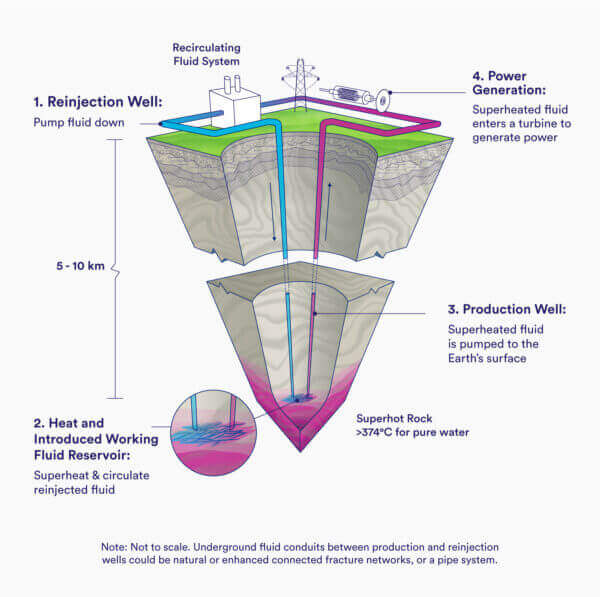
Conventional geothermal power is produced from naturally heated groundwater close to the surface and generally at temperatures of 150-200°C. Superhot rock energy will be produced by drilling into hotter rock at deeper depths (>400°C), injecting and circulating water through the rock to heat it to very high temperatures, and then pumping it back to the surface to a generation plant. With successful deep drilling innovation, superhot rock energy could be produced anywhere in the world and will not be limited to regions with shallow heat and groundwater.
Water above 400°C is in the “superhot” (supercritical) state, which is much more energy-dense and can circulate more efficiently than lower-temperature water. These properties will allow superhot rock energy systems to produce an estimated 5-10x the energy of conventional geothermal systems – giving it the potential to be competitive with today’s costs for power. This high energy potential has been demonstrated in Iceland, where the Iceland Deep Drilling Project’s Krafla borehole produced superhot water at 452°C and an estimated 36 megawatts of energy (MWe) production potential. In comparison, a conventional geothermal project produces about 7-8 MWe per well.
Though humans have been using geothermal energy for over 100 years, (starting in Tuscany, Italy, in 1904) it’s only recently that technological advancements have made superhot rock energy a possibility. As of 2018, there were only 15 GW of conventional geothermal power in the world and geothermal accounted for less than 0.5% of total global electricity production. Because of its dramatically higher energy capacity and “geothermal everywhere” potential, superhot rock energy can be a much larger source of power, potentially on a terawatt scale.
Where can superhot rock energy be developed?
The temperatures required to create superhot rock energy have already been accessed in regions where the earth’s heat is near the surface, such as Iceland, Italy, Turkey, or the Western U.S. These shallow-heat regions will likely be the first regions where superhot rock energy will be developed. However, superhot rock has the potential to be deployed on a global scale, almost anywhere in the world. Achieving “geothermal everywhere” will require innovative drilling technologies that can cost-effectively reach superhot resources at depths of up to 15 km/~9 mi (compared to depths of 7 km/~4 mi accessible through current drilling methods). There are several companies currently working to push the limits of today’s drilling, and the innovations needed are engineering innovations rather than major scientific breakthroughs.
How much will it cost to generate superhot rock energy?
Clean Air Task Force commissioned Hot Rock Energy Research Organization (HERO) and LucidCatalyst to estimate the levelized cost of energy for future mature (“nth of a kind”) superhot rock power plants. Levelized cost of energy (LCOE) is a standard measurement in the energy industry that is used to compare the cost of energy sources and is calculated by dividing the lifetime cost of a power plant by the total energy produced by that plant. Results suggest that mature superhot rock will be competitive at $20-35 per MWh, compared to $40 per MWh, the current U.S. market price for electricity.
Is superhot rock energy renewable, or does it risk depleting the Earth’s heat?
Superhot rock energy does not risk depleting the Earth’s heat. On human timescales, superhot rock energy is endless, the ultimate renewable resource. One estimate suggests that 0.1% of the Earth’s heat could meet our world’s energy needs for 2 million years. Scientists predict that the Earth will continue to produce geothermal heat for billions of years, and the amount of energy needed by humans is tiny compared to the energy produced. Human geothermal use will not affect the Earth’s heat in any meaningful way.
Does superhot rock energy produce CO₂?
The Earth’s heat is a carbon-free energy source. Unlike fossil fuel power, no direct carbon dioxide (CO₂) will be emitted in the process of generating power in dry rock. Superhot rock also represents an advantage over commercial hydrothermal geothermal systems, which harvest hydrothermal fluids that sometimes contain carbon dioxide. Because superhot rock energy will work in hot dry rock, which is highly unlikely to contain free CO₂, it’s envisioned as an entirely carbon-free form of energy.
Is superhot rock energy the same thing as supercritical geothermal energy?
“Supercritical” is a technical term that refers to water that has heat at or above 400°C and pressure at or above 22 MPa. “Superhot” is a less technical term that refers to water at or above about 400°C, regardless of pressure, as well as to other very hot fluids.
What are engineered geothermal systems (EGS) and hot dry rock systems, and how do they relate to superhot rock energy?
Geothermal energy typically requires a heat source (rock), water, and permeable rock so that the water can circulate through it and absorb the heat. In geothermal systems where hot rock does not contain a natural source of water and permeability, permeability must be created. Engineered geothermal systems (EGS) are geothermal systems that do not use natural hydrothermal water. They have also been referred to as “hot dry rock systems.”
Superhot rock energy is a subset of EGS that accesses much hotter temperatures (above 400°C) than EGS has historically accessed. “Direct-contact” superhot rock works by pumping water down one pipe into hot rock, where it circulates through tiny fractures in the rock to absorb heat, and then rises up a second pipe to the surface. An alternative to circulating water through fractures may be closed-loop injection systems, which heat water inside deep drilled conduits or pipes through the hot rock at depth.